The earliest bat fossils reveal creatures that were not much different from present-day bats. They possessed wings and had the same anatomical traits as modern bats. These ancestors nonetheless retained some characteristics of their non-flying predecessors.
08.21.24
By Paul Hormick

All in all, bats are pretty mysterious. They fly and are the only mammals to do so. They also live in caves, places that people and most other critters don’t wander into. Just as enigmatic, bats’ evolutionary story is filled with puzzle after puzzle, and scientists still have many questions as they try to figure out how bats became, well…bats.
Not much remains of bats’ fossil record. Being smaller animals, the bones of early bats were susceptible to breaking down and decomposing, giving them little chance of being preserved as fossils. Long after paleontologists had dug up dinosaur bones and skeletons of woolly mammoths, they had yet to find the remains of a single early bat species. In recent decades, scientists have unearthed a small number of bat fossils—teeth, jaws, occasionally entire skeletons—in places as far-flung as Wyoming, Paris, and India.

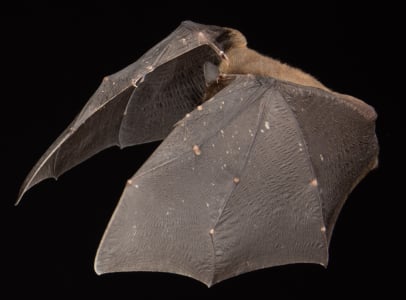
Adding to the mystery of their evolutionary development, bats appear in the fossil record seemingly out of the blue. There are no earlier fossils of proto-bats, creatures that could morphologically show bats’ links with other related mammal species or the development of their forelimbs into wings. The earliest bat fossils reveal creatures that were not much different from present-day bats. They possessed wings and had the same anatomical traits as modern bats. These ancestors nonetheless retained some characteristics of their non-flying predecessors. For modern bats, a claw remains on the anatomical equivalent of their thumb, while the oldest fossils of bats had claws on all five fingers, leading scientists to believe these early bats may have been tree climbers as well as fliers. That being said, many bat experts believe the ancestor of all bats was a flightless, forest-dwelling creature that lived around 64 million years ago.
Recent advanced genetic research has helped scientists to fill in some blanks in bats’ evolutionary story, finding that bats first evolved about 50 to 52 million years ago during the early Eocene in the northern stretches of the supercontinent Pangaea, the portion of the ancient landmass that is now North America and Eurasia. This evolutionary timeline was further confirmed in 2023, when the oldest bat fossil was unearthed in Wyoming and also dated to the early Eocene.

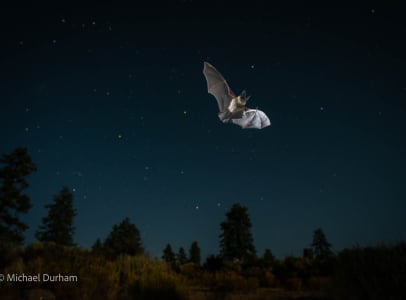
Having no transitional fossils of their flightless ancestors, the evolution of bat flight is a source of scientific conjecture. Bats are known for hanging around upside down, and this trait might have led to them taking to the skies. Some bat experts think that bat ancestors lived in trees, their limbs becoming elongated from climbing tree trunks and branches. The long limbs further developed for hanging under branches and gliding. A clue to this development might be found in a modern-day South Asian colugo, an animal that uses its long limbs to outstretch folds of skin like a kite to glide from tree to tree.
Proto-bats may have lived in trees and found food among the branches and leaves, but why glide? Why take flight? Climbing up and down trees takes energy. Traveling on the ground between trees may have also exposed bat ancestors to predators. Jumping from tree to tree would have solved these problems, and evolving the ability to glide would have enabled these ancestors to reach trees farther away. From there, evolving the ability to fly aided or enabled bats to catch flying or fast-moving prey, such as flying insects.
Many bat experts believe the ancestor of all bats was a flightless, forest-dwelling creature that lived around 64 million years ago.
It might seem like a simple transition, going from gliding to flying, but true, sustained flight achieved through the flapping of wings, is complex and presents a leap in evolutionary development that is still difficult to explain. Yet, taking to the skies was the key step that led to the next great step in bat evolution. Flight enabled bats easier access to food sources—insects, fruits, nectar from flowers, etc.—and to exploit new habitats. With all these new resources available, bats diversified and speciated quickly. By the end of the Eocene, all bat families had developed in what is described as an evolutionary “big bang” unique among mammals. Bats also diversified profusely, developing into over 1,400 species comprising 20 percent of all mammal species.

https://doi.org/10.1371/journal.pone.0283505.g003
Almost all bats are nocturnal, an evolutionary development best explained by the existence of birds, which evolved during the Jurassic Period, at least 100 million years before bats came into existence. Scientists have theorized that by the time bats took wing, insect-eating birds, such as swifts and swallows, had monopolized the smorgasbord in the sky, forcing bats to hunt insects after the sun went down.
Uncovering the natural history of bats can help us better understand and appreciate the thousands of bat species that pollinate flowers, control insects, disperse seeds, and fit other important ecological niches. Stay tuned for more about echolocation and other aspects of bat evolution in part two of our bat evolution series.