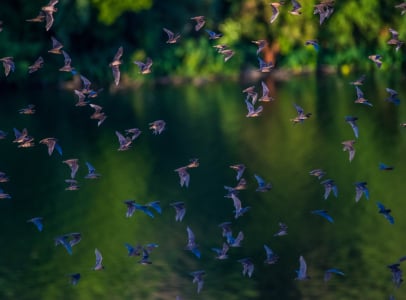
All domestic cats that spend any amount of time outdoors, whether they are free roaming house cats, stray, or feral, pose a threat to bats.
01.10.25
By Paul Hormick

If dogs are human’s best friend, cats are a close second. They fill our homes with companionship and cuddles. Yet some of our tabbies, tortoiseshells, and beloved furballs can also create problems for wildlife, including bats.

All domestic cats that spend time outdoors, whether they are free roaming house cats, stray, or feral, pose a threat to wildlife and biodiversity, especially birds and small mammals. In the United States, it has been estimated that free-ranging domestic cats kill up to four billion birds and almost 23 billion mammals every year. In the United Kingdom cats kill an estimated quarter million bats each year
For those of us who are cat lovers, this may be difficult to hear, but conservationists and ecologists consider free-ranging domestic cats and feral cats to be an invasive species. Cats are responsible for the extinction of 33 bird species worldwide and have been a factor in extinctions of species living on islands. Long thought to be practical and safe to control pests, cats actually exacerbate rodent problems instead of control them. Cats aren’t devils. They mean no harm and are only following their instincts, but housecats may be the single greatest source of human influenced mortality of wildlife in the world.
Although there has been anecdotal evidence of the threat cats pose to bats for at least the past 30 years, few studies have examined this threat carefully. The gaps in our knowledge on this topic began to change recently, when researchers in New Caledonia, a small, French territory in the southwest Pacific, noticed bat remains in the scat of feral cats on the small island, including remains of all three large bat species that live in New Caledonia: Pacific flying foxes, New Caledonia flying foxes, and ornate flying foxes. They recorded remains of fruit bats of the island in the scat as well. They had known smaller bats were preyed upon by cats, but the larger bats were a surprise.
Cats are responsible for the extinction of 33 bird species worldwide.

These observations prompted the scientists to review the existing literature on cat-bat predation; they found that 86 bat species throughout the world are preyed upon by cats, and about a fourth of these species are listed as Near Threatened, Threatened by the IUCN. Further, the team discovered that cats prey on all types of bats — insectivores, fruit bats, flying foxes, etc. — throughout all types of habitats the world over. Basically, wherever there are bats and free-roaming cats, bats suffer.
Bats that forage close to the ground are the most susceptible to being caught by a cat. Fruit bats eating fruit that has fallen to the ground are especially vulnerable to being pounced upon by cats. Cities and towns, where the numbers of feral and stray cats are concentrated, present greater danger to bats than forests, grasslands, or other open areas.
Cats prey on all types of bats throughout all types of habitats the world over. Basically, wherever there are bats and free-roaming cats, bats suffer.

Jamaica
In Jamaica, which has 21 species of bats, five endemic to the island, researchers have actually observed cats in their hunt for bats. Cats wait at the entrances of this Caribbean island’s caves, and they snag bats as they fly out for their night’s foraging. Pregnant females and juveniles offer the easiest prey.
Scientists have seen cats hunting at a cave situated in a rural area north-west of Kingston, where an estimated two million bats belonging to ten different species make their homes. This cave is the only roost where the critically Endangered Jamaican greater funnel-eared bats live. Only about 250 individuals of this species are thought to remain. Cats also hunt bats at Jamaica’s Stony Hill Cave, home to three species of bats, including the critically Endangered Jamaican flower bat. In 2022 BCI, working in partnership with the Jamaican Natural Resources Conservation Agency and NEPA, purchased the land around Stony Hill Cave, saving the region from development and the possibility of an increased housecat population. In partnership with the Polly Ground community and the National Environment and Planning Agency (NEPA), BCI has been installing predator-exclusion fencing around the cave entrances that will help keep cats away from the cave entrances and provide the bats living in the cave a little more safety from predators as they emerge. (Learn more about BCI’s Endangered Species Intervention work in Jamaica here.)

Saving Bats from Cats
Cats and bats don’t mix. Period. If you have a purring family member, you can do your part to help keep bats and other wildlife safe by keeping your cat indoors. Because cat attacks are one of the most common causes of bat (and bird) casualties, keeping cats indoors – or at the very least, at night, especially during summer months when bat mothers are feeding their young – can help protect your local bat population. If your cat finds a bat, it may learn where the roost is located, which places an entire colony at risk. If your community has a feral cat coalition you could join or otherwise support their work. By helping to control feral cat populations you can make your community and the rest of the world a safer place for bats.
Learn more about BCI’s Endangered Species Campaign at: batcon.org/nightwatch.