Part 2 of the evolutionary relationships in the bat family tree.
11.04.26
By Alyson Brokaw

Of the many incredible things that bats can do, echolocation may be among the most impressive. It is a deceptively simple concept — produce a sound and listen for the echoes. And while other animals are known to use sound to navigate in dark or difficult conditions, some with high levels of sophistication (looking at you, dolphins), bats arguably do it best. And traditionally, the presence or absence of echolocation was thought to be an important feature in differentiating between different types of bats. Megachiroptera (megabats) didn’t echolocate while Microchiroptera (microbats) did. But then advances in molecular and genetic tools revealed that nature was not so simple and living bats were divided into two new suborders: Yinpterochiroptera and Yangochiroptera. While some echolocating bats are now grouped with the megabats (see Part 1: “The Yin of Bats” for more on this suborder), the rest of the formally “microbats” are now classified in the suborder Yangochiroptera.

(Most of) The Echolocating Bats
All bats in Yangochiroptera use laryngeal echolocation, producing high-frequency calls using their larynx (or voice box). All mammals have a larynx, which includes bands of muscles and mucous membrane called vocal folds. Movement of air and contraction of these vocal folds results in sound production. Bats can contract their vocal cords up to 200 times a second, resulting in their high-pitched calls. Echolocating bats also have an impressive vocal range, enabling them to produce sounds over an eight octave range (most mammals can only span three to four octaves). To produce lower frequency sounds, like those used in social communication, bats use “death metal growls,” vibrating a different set of membranes above the vocal folds called ventricular folds.

In addition to frequency, Yangochiropteran bats show wide variation in the loudness of their calls. Some bats can be so loud, it’s a good thing humans can’t hear them! Greater bulldog bats (Noctilio leporinus) can produce calls as loud as 140 decibels — that’s as loud as a jet engine. On the other end of the spectrum, many bats produce very quiet calls. For bats like western barbastelle (Barbastella barbastellus) and brown long-eared bats (Plecotus auritus), being quiet when echolocating makes it easier to sneak up on their moth prey. For hoary bats (Lasiurus cinereus), producing very quiet “microcalls” is thought to help them avoid aggressive interactions with other hoaries.

Meet the Yang Bats
Yangochiropteran bats make up approximately 60 percent of all bat species, across 14 different families. Yang bats can be found across the globe, with an impressive range of diversity across diet, foraging strategy, roosting habitat, body size, and social behaviors. Let’s meet them!

Myzopodidae (sucker-footed bats): Found only in Madagascar, the sucker-footed bats are a small family of just two species. Unlike most other bats that roost upside-down, sucker-footed bats roost head up, clinging to the inside of tropical leaves with the help of special pads on their wrists and ankles. Despite their name, they don’t actually cling using suction, they instead rely on wet adhesion using fluid secretions from the pads.

Emballonuridae (sac-winged bats): This family consists of a range of species from across the world’s tropics and subtropics, including the sac-winged bats, sheath-tailed bats, pouched bats, and tomb bats. As indicated in the common name, many species have sac-shaped glands in their wings, which are thought to play a role in communication. Male greater sac-winged bats (Saccopteryx bilineata) mix their own “perfumes” in their wing sac using urine and gland secretions, which they then waft at females as part of their courtship rituals. Many of these bats roost in more open spaces such as outside of cliffs, trees, or walls, sporting mottled brown and grey fur with white stripes that help them camouflage against their roost backgrounds.

Nycteridae (hollow-faced bats): Also known as slit-faced bats, hollow-faced bats are found across much of Africa and parts of Asia (mainly Malaysia and Indonesia). They are named for the distinctive groove running between their eyes and down to their nose. Roosting habits are varied, with slit-faced bats observed roosting in caves, hollow trees, burrows of other animals, and even pit toilets! Most feed on insects or other arthropods, but at least one species (large slit-faced bat, Nycteris grandis) is known to hunt larger prey such as frogs and birds.

Furipteridae (thumbless bats): These tiny bats actually DO have thumbs — they are just small and hidden inside of their wing membranes. Comprised of two Neotropical species, thumbless bats are cave roosting specialists, relying on cave habitats in tropical regions of Central and South America. In areas where these bats occur, they are rare, and there is still much to be understood about them.

Mormoopidae (mustached bats): These unique-faced bats are named for the leafy projections on their lips, giving some of them a mustached appearance. Morphological variations abound in this family, including the flower-like face of the ghost-faced bat (Mormoops megalophylla) and the stretch of membrane across the backs of the naked-backed bats (Pteronotus davyi). Mustached bats form large colonies throughout Central and South America, preferring the heat and humidity of tropical caves. Parnell’s mustached bat (Pteronotus parnelli) is also one of the few Yang bats to produce constant-frequency echolocation calls (the type made by horseshoe and Old World leaf nosed bats).

Mystacindiae (New Zealand short-tailed bats): The New Zealand lesser short-tailed bat (Mystacina tuberculata) is one of New Zealand’s two species of native terrestrial mammal. They are highly adapted to life in the forest, content to spend large amounts of time scurrying around on the forest floor. It is on the ground that they act as an important pollinator for the New Zealand wood rose, though they also feed on insects and other arthropods. They are also excellent singers, with males sharing singing perches and producing fast, elaborate sequences of songs. Sadly, there used to be two species of bats in this family, but now there is only one. The New Zealand greater short-tailed bat (Mystacina robusta) has not been seen since 1965 and is presumed extinct.


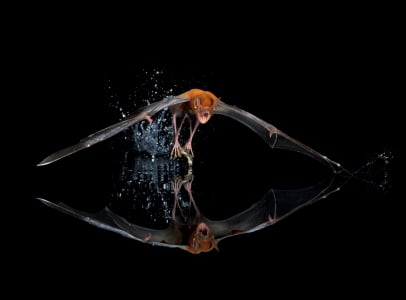
Nocilionidae (bulldog bats): Bulldog bats are Neotropical bats best known for their unusual fishing abilities. The greater bulldog bat (Noctilio leporinus), in particular, is a skilled predator of fish, using echolocation to detect the tiny ripples fish create at the water’s surface. Once a target is located, the bat skims over the water and scoops up its prey with its unusually large feet and long claws. The lesser bulldog bat (Noctilio albiventris) is mainly an insectivore, though it is still closely tied to bodies of water where it forages for emerging insects.

Phyllostomidae (New World leaf-nosed bats): If there were a prize for ecological variety, the New World leaf-nosed bats would be serious contenders. This exceptionally diverse family includes bats of many sizes and lifestyles, with diets ranging from fruit and nectar to insects, small vertebrates, and blood. Even their nose-leaves show remarkable variation, from the highly reduced noseleaf seen in vampire bats to the long and pointy noseleaf of the sword-nosed bat (Lonchorina aurita). Diet is thought to be a primary driver for the physical and behavior variation seen in this family and they have it all covered: Nectar bats with long noses and even longer tongues, small and medium-large fruit bats to disperse seeds, and a variety of carnivores. The spectral bat (Vampyrum spectrum) is the largest bat in the western hemisphere with a wingspan of up to 3 feet and eats a range of vertebrates, including other bats. This bat was also recently shown to be quite the family bat, with adults and yearling bats bringing food back to the roost to feed younger pups. And of course, don’t forget the common vampire bats (Desmodus rotundus), known for their highly specific diet and complex social bonds.

Thyropteridae (disc-winged bats): Like the sucker-footed bats who are found half a world away, disc-winged bats also roost head-side up. However, unlike the sucker-footed bats, disc-winged bats use a combination of wet adhesion and suction to roost inside furled up leaves. To keep track of roostmates across various leaves, they have a call-and-response system of communication. Searching bats emit special “inquiry” calls and listen for the response calls from bats that have already found a roost.

Cistugidae (wing-gland bats): Wing-gland bats are a small family consisting of just two species, both found in southern Africa. These small bats feed mainly on insects and inhabit dry savannas and hot desert environments. They were once classified within the large family Vespertilionidae, which includes familiar mouse-eared bats, but molecular research revealed that they are distinct enough to warrant their own family.

Miniopteridae (bent-winged bats): Bent-winged bats are Old World insect eaters found across parts of Africa, Europe, Asia, and Australasia. Their name comes from a distinctive feature of their wings: an exceptionally long third finger that can fold backward when the wings are tucked away. Their long, narrow wings are well suited to fast flight, particularly in open spaces, and many species are capable of traveling considerable distances. Caves are especially important to these bats, providing shelter and suitable conditions for large roosting colonies. In temperate regions, some species also hibernate through the colder months, conserving energy when insects become scarce.

Molossidae (free-tailed bats): Free-tailed bats are built for speed. Their name comes from the tail, which extends beyond the tail membrane, while their long, narrow wings help them fly quickly through open air. Among the best-known members of the family is the Mexican free-tailed bat (Tadarida brasiliensis), famous for forming enormous colonies in the southern United States, particularly Texas. Over in Asia, wrinkle-lipped bats (Mops plicatus) form similarly large colonies, numbering in the millions. Each night when these bats head out to hunt, they are also providing free pest control, saving farmers millions of dollars as they feed on moths, plant hoppers, and other pests.

Natalidae (funnel-eared bats): Funnel-eared bats are small, agile insect-eaters found in the Neotropics, where many species roost in caves. Their most obvious feature is their large, funnel-shaped ears, which contrast with their tiny eyes and delicate bodies. Unfortunately, some species have very restricted distributions, including island endemics such as the Jamaican funnel-eared bat (Natalus jamaicensis), which is currently listed as Critically Endangered by the IUCN RedList.

Vespertilionidae (vesper bats): With more than 300 species, the vesper bats form one of the largest and most widespread bat families. They occur across much of the world and include many of the small bats many people picture when they think of bats. While most bats in this family eat insects, a few have more exotic tastes. Pallid bats (Antrozous pallidus) in the southwest United States will feed on nectar and fruit from cactus, fishing myotis (Myotis vivesi) use their long toes to hunt fish and small marine invertebrates, and greater noctule bats (Nyctalus lasiopterus) were recently recorded taking down migratory birds in flight! In temperate regions, they often dominate local bat communities, and many species spend the winter hibernating in caves, mines, or other sheltered places when insects become difficult to find. Yet the family is far from uniform in appearance or behavior. Some species have striking coats, including the boldly patterned painted bat (Kerivoula picta) and the spotted bat (Euderma maculatum), while others have unusual facial features, such as the tube-like nostrils of tube-nosed bats.
As habitat loss, climate change, and other human pressures threaten bat populations around the world, understanding their evolutionary history can help us make better-informed decisions about which species and habitats need protection most urgently.
With 1,515 species and counting, there is still plenty to learn about these flying mammals. Advances in genomic tools and collaborative science like Bat1K project’s effort to sequence the genomes of all living bats will likely lead to new and surprising discoveries about how bats are related and how they evolve. As habitat loss, climate change, and other human pressures threaten bat populations around the world, understanding their evolutionary history can help us make better-informed decisions about which species and habitats need protection most urgently. The more we learn about how bats came to be so diverse, the better equipped we are to ensure that diversity survives into the future.
*Learn more about the Yin of bats in Part 1
Alyson Brokaw, PhD is a behavioral ecologist, sensory biologist, science communicator, and a regular contributor to The Bat Pub. When not talking about bats, she can be found cuddling with her dog, exploring her local Pennsylvania woods and throwing plastic on the ultimate frisbee field.