Uranium Mines Have a Complicated Legacy in Colorado — But Provide Vital Refuge to Bats
11.29.24

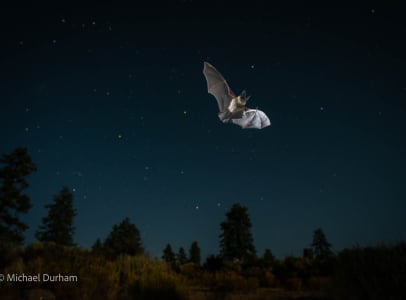
BCI’s Subterranean Team works closely with federal, state, and private land managers to identify and evaluate abandoned mines serving as bat roosting sites. The estimated 500,000 abandoned mines throughout the United States present many potential dangers to human health and the environment; therefore, state and federal government agencies are tasked with reclamation and closure of these hazards through abandoned mine land (AML) programs. Yet many of these abandoned mines have become significant habitat for bats as they seek refuge from encroachment by human development.

A Historical Overview
To understand the connection between bat refuge and abandoned mine land in the U.S., we need to take a deeper, acronym-heavy dive into the history and collaborative work it took to get where we are today.
The Department of Energy, Office of Legacy Management (DOE-LM), Defense-Related Uranium Mines Program (DRUM) kicked off in 2017 with a focus on 3,472 legacy uranium mines located on lands managed by federal, state and tribal, and private owners. The mines under DRUM oversight have a production history from around 1947 to 1970 and provided uranium ore to the U.S. Atomic Energy Commission for defense-related activities. In 2020, BCI’s Habitat Protection & Restoration Program (HP&R) officially entered partnership with DOE-LM to support their DRUM effort.
Many of these abandoned mines have become significant habitat for bats as they seek refuge from encroachment by human development.
“The DOE DRUM/BCI partnership was born over a decade ago when the DOE was planning to conduct field verifications of abandoned uranium mines,” says HP&R Director, Jason Corbett. “We have formed an exceptional partnership in helping the DOE DRUM Program with their mission, while also accomplishing ours by protecting critical roosting habitats for bats in abandoned uranium mines.”

The primary objective is to safeguard hazardous abandoned mines, but it is also vitally important to protect wildlife habitat and cultural resources.In this way, the process takes a holistic approach to conservation.
The DRUM safeguarding effort is dynamic, with each partner bringing their own set of mandates and resource considerations. For instance, when safeguarding hazardous features on Bureau of Land Management (BLM) land, BLM is responsible for ensuring that DRUM projects adhere to federal environmental regulations and BLM management directives. The Colorado Division of Reclamation, Mining and Safety (CO DRMS), which oversees abandoned mines across the state, facilitates the mine safeguarding process.
In March 2024, the DOE invited project partners involved in abandoned mine lands (AML) work in Colorado, including BCI, the BLM, CO DRMS, and contractors to collaborate and discuss ongoing and future work in the state. The meeting took place in Gateway, Colorado, a one-gas-pump town at the geological confluence of the Unaweep and Dolores River Canyons in the heart of Colorado’s uranium country.

BCI’s Multifaceted Role in the DRUM Program
BCI plays an integral role in the mine closure process. Our Subterranean Team leads the underground mine surveys and documents signs of bat use, which may include live or dead bats, guano, and insect parts indicative of feeding. The survey teams also record other wildlife use at the site and use those observations to make (or form) their closure recommendations.
Concurrently, a cultural resource team visits the same sites to record notable cultural resources and comply with Section 106 of the National Historic Preservation Act. This work may be done in-house by BCI’s Cultural Team, a sub-contractor, or a partner cultural resource specialist.
“BCI’s Cultural Resources team conducts archaeological surveys before the mines are closed,” says Autumn Cool, BCI’s Cultural Resources Coordinator. “We study the history and physical remains of the abandoned mines to ensure that historically important places are recorded and protected during our work.”
BCI plays an integral role in the mine closure process. Our Subterranean Team leads the underground mine surveys and documents signs of bat use.
After all the surveys are complete, BCI helps to coordinate the development of documentation to satisfy National Environmental Policy Act (NEPA) requirements that apply to federal projects. BCI works hand-in-hand with the project partners to develop the NEPA document. BCI also assists in the final stages of the safeguarding process to ensure that mine closures do not adversely affect any natural or cultural resources that may exist at the project sites.

“The relationship with the DOE has facilitated the growth of the HP&R program over the last few years and has allowed us to expand our program offerings,” says Aaron Sidder, BCI’s Compliance & Ecology Coordinator. “It is truly a win-win: our expertise has helped the agency act quickly to make public lands safer, and we’ve been able to protect a lot of bat habitat in the process.”
DOE’s DRUM program sunsets in 2030. BCI plans to continue partnership with DOE through the end of the DRUM program. Meanwhile, mine safeguarding continues. In Colorado, three projects are scheduled for construction in 2025 and many more in the works for the following years. Additional DRUM safeguarding projects are also underway in Montana, Utah, and Wyoming.
Learn more about BCI’s Abandoned Mine Land program work.