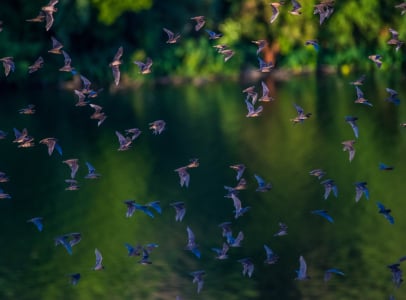
Many of Africa’s bat species rely on ancient caves for shelter and reproduction.
12.19.24
By Alyson Brokaw

Photo by Horizonline Pictures
Dotting the coastal landscape of Kenya and Tanzania are ancient limestone caves. Formed from the shells and exoskeletons of ancient corals and sea creatures, these caves are the last refuges for the endangered Hildegarde’s tomb bat (Taphozous hildegardeae). Endemic to this region, these bats are found only in a geographic area of around 700 square miles ̶ that’s smaller than the entire state of Rhode Island! The actual area of suitable habitat used by the bat is much smaller and they are currently only found roosting in a handful of these coastal caves. The forest habitat used by these bats is increasingly fragmented, due to encroaching development, deforestation, and other types of disturbance.
Bats make up 27 percent of Africa’s mammal species and play important roles as pollinators, seed dispersers, and pest control throughout the continent.

When most people think of African mammals, they likely imagine the majestic lion or towering giraffes ̶ not the humble bat. Bats make up 27 percent of Africa’s mammal species and play important roles as pollinators, seed dispersers, and pest control throughout the continent. Like Hildegarde’s tomb bat, many of Africa’s bat species rely on caves for shelter and reproduction. Negative attitudes towards bats in these regions can also lead to persecution and destruction of roosts. African bat conservationists, such as Dr. Paul Webala, a professor at Masaai Mara University, have long championed the protection of Kenyan bat caves. Rapid development, especially in coastal areas, is also placing these important caves at risk. These threats also caught the attention of Dr. Isabella Mandl, BCI’s Regional Director for Africa and Asia, who began networking with Dr. Webala and local community members on how to best protect these coastal roosts.

In line with these efforts, BCI recently moved forward with purchasing a plot of land in the area of Watamu, about 105 km north of Mombasa, and the site of Kaboga Cave. This cave is one of the few remaining caves where Hildegarde’s tomb bat can be found. Ownership of the land has since been transferred to Kenyan partner organization Angaza Vijiji, with whom BCI is creating a management plan. Integral to this work is Dr. David Wechuli, a Kenyan bat scientist (and BCI scholar) who was recently hired as BCI’s Kenya Program Manager and has extensive experience working in these communities. As Dr. Mandl describes, “This is very much not a research project, but a multifaceted effort focusing on cave roost protection through outreach and applied skill-building within the communities.”.

South of the Kaboga Cave site, nestled in the far southeast corner of the country is the village of Fikirini and the Three Sisters Cave. With four distinct chambers within the cave complex, three of which are occupied by bats, this site is another important roost site for the Hildagarde’s tomb bat. These caves also hold important cultural significance, with local community members using one of the caves for traditional ceremonies. The Three Sisters Caves also was an important refuge during the slave trade in the mid to late 1800s.
Kenyan coastal caves are not just home to the Hildegarde’s tomb bat, but several other unique and important African bats, including Egyptian fruit-eating bats (Rousettus aegyptiacus), near-threatened bats like the striped leaf-nosed bat (Macronycteris vittatus) and Decken’s horseshoe bat (Rhinolophus deckenii), and the data-deficient Least long-fingered bat (Miniopterus minor), among others. The periodic shafts of light, long, hallway-like passages and sheer number of bats make for a stunning spectacle come dusk, a moment captured in exquisite detail by Chris Gallaway, the filmmaker behind BCI’s new cave conservation series “Night Watch.”

The BCI team is working with the Fikirini community to develop sustainable management practices that will preserve this culturally and ecologically important site. This includes close collaboration with Angaza Vijiji, a Kenyan organization that specializes in green enterprise development to help the community develop skills needed to manage the cave and gain income from their efforts. Dr. Paul Webala is also involved as an advisor, with students and early-career bat researchers in Kenya collecting ecological and monitoring data on the bats, and whose results help shape on-the-ground management decisions.
The story of the tomb bat is one of resilience ̶ despite encroaching disturbance, the bats have continued to hang on in these caves.

In some ways, the story of the tomb bat is one of resilience ̶ despite encroaching disturbance, the bats have continued to hang on in these caves. It also highlights the importance of taking action now, before it’s too late. When asked what she hopes will be the future of these efforts and BCI’s work in Kenya, Dr. Mandl expresses hope and optimism. “This is about giving the communities we work with the tools to sustain the conservation of bats on their own and to enable them to protect their land from development and exploitation,” she says. “Community is the heart of this project. Our work is informed by research results but it very much depends on a holistic approach to conservation to succeed.”