


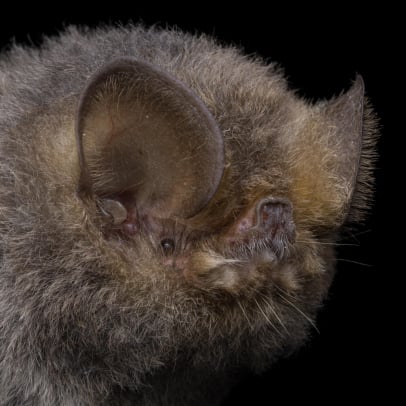
- Common Name
- Smoky Bat
- Scientific Name
- Amorphochilus schnablii
- Status
- Vulnerable
- Location
- South America
THE GOAL OF THIS INITIATIVE IS TO CREATE ARTIFICIAL ROOST NETWORKS IN PERU’S DESERT VALLEYS TO SAVE THE SMOKY BAT FROM EXTINCTION
The Need
The smoky bat has experienced a catastrophic 50% population decline over the past decade, driven by unregulated gold mining destroying its roosting habitat across Peru’s coastal valleys. This species, now classified as endangered by the Peruvian government, faces imminent extinction as mining expansion eliminates its roosting sites while forcing remnant populations to occupy houses, creating conflict with local communities. Small colonies of fewer than 30 individuals persist in precarious conditions, yet no maternity colonies have been discovered in these roosts, indicating reproductive failure that will accelerate population collapse without immediate intervention. The species’ restriction to Peru’s arid coastal plain, combined with rapid habitat loss, creates an extinction trajectory measured in years rather than decades.
Our Approach
Building on successful pilot work demonstrating that smoky bats readily occupy artificial roosts constructed using Peru’s traditional quincha methods, this initiative will deploy over 50 specially designed structures across four priority valleys— Ocoña, Majes, Acari, and Quilca. These artificial roosts provide thermal stability essential for reproduction, with pilot installations already attracting not only Smoky bats but also the IUCN-endangered Myotis atacamensis and Glossophaga valens, an important pollinator for the region. Strategic placement informed by known roost sites maximizes occupancy rates while partnering with agricultural landowners leverages government-approved tax incentive programs, creating economic motivation for long-term roost protection.
Our Impact
The initiative aims to establish protected populations totaling at least 1,000 smoky bats distributed across multiple valleys, creating redundancy and genetic diversity essential for species recovery. Beyond immediate population stabilization, the artificial roost network provides a replicable model for protecting Peru’s other threatened bat species inhabiting the coastal plain, where half of the country’s endemic bat fauna is concentrated in valleys increasingly pressured by agriculture, urbanization, and resource extraction.
About The Bat
The Smoky Bat Team

Melquisedec Gamba-Rios, Ph.D. – Regional Director, Latin America & Caribbean
Melquisedec is the ESI Team’s Regional Director for Latin America and & Caribbean Initiatives. In this role, Melqui is responsible for identifying priority areas for the Endangered Species Interventions team to focus, and work with in-country partners to co-develop effective strategies to protect and recover endangered bat species, populations, or habitats.
Melqui has been working with bat ecology and conservation for over 20 years. Originally from Colombia, Melqui conducted most of his research work in Costa Rica. He received his Ph.D. from the University of Tennessee-Knoxville, where he investigated antipredator behaviors in bats and the implication in bat communication and sociality. He has published work on topics including species distribution, habitat selection, and roost requirements for multiple bat species, with a particular emphasis on the neotropics.

Jon Flanders, Ph.D. – Director, Endangered Species Interventions
Dr. Jon Flanders is responsible for leading conservation initiatives that effectively address BCI’s global conservation priorities. With over 20 years of experience working on conservation projects across the globe, Jon recognizes the importance of partnerships in delivering social, environmental and economic benefits. Working with a range of organizations, from small non-profits to government departments he can strategically prioritize projects that balance conservation needs with sustainability.
Jon received his Ph.D. from the University of Bristol where he integrated investigations of the ecology, diet, and population genetics of the greater horseshoe bat to advance its conservation. Prior to joining BCI, Jon had worked extensively across Asia and Central America leading a variety of conservation-related research projects, as well as teaching workshops and outreach efforts for local researchers and students.
Jon is an Adjunct Professor in Ecology and Evolutionary Biology at Tulane University and a Research Associate at the American Museum of Natural History.