Some say that all bats use camouflage, darkness concealing them as they fly about and pursue their prey in the night skies. But the truth is even more complex.
09.25.24
By Paul Hormick

Camouflage is the method or ability of animals to conceal themselves. It can be the coloration, pattern, or shape of an animal, like a praying mantis looking like a stick, or the pattern of a snake’s scales enabling it to blend in with its surroundings. Camouflage is often associated, but not the same as mimicry, which is an animal’s ability to thwart prey through behavior. For example, many marine species blend in with their surroundings by swaying along with the eelgrass in estuaries.

Most folks think of camouflage as prey cloaking themselves from predators, but predators also use camouflage to avoid being detected as they hunt their prey. Lots of animals use camouflage. Zebras’ stripes dazzle and confuse predators; green katydids look like leaves; and color-shifting chameleons look like just about everything.
For animals preyed upon by bats, being seen isn’t the problem, it’s being heard. If you’re a bug or a beetle, you don’t want to be picked up by a bat’s echolocation calls. The suraka silk moth, a very large moth native to Madagascar, has found a way to be acoustically incognito from bats. Its thick “fur”(actually modified scales) absorbs as much as 85 percent of the vibrations from echolocation calls, rendering the moth almost invisible to bats seeking them out for an evening dinner. Tiger moths achieve similar cloaking, as they emit high pitched “clicks” that jam bats’ natural sonar.

For animals preyed upon by bats, being seen isn’t the problem, it’s being heard.
On the other hand, bats have found ways to overcome the camouflage of the insects they prey upon. A moth or any other insect perched on a leaf would seem to be invisible, acoustically camouflaged, from echolocation calls, yet bats readily find and catch them. In 2019, scientists at the Smithsonian Tropical Research Institute discovered as bats approach leaves at oblique angles, their echolocation calls are reflected back by the bodies of the insects, but reflected away by the leaves, letting them find their prey.

Bats use camouflage
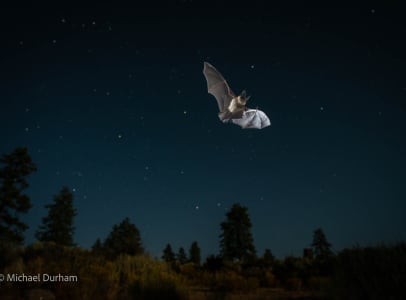
Some say that all bats use camouflage, darkness concealing them as they fly about and pursue their prey in the night skies. Although bats probably evolved nocturnal lifestyles to avoid competition with birds over prey, there may be a kernel of truth to this idea that the cloak of darkness gives a certain amount of protection to the bat species that come out at night.
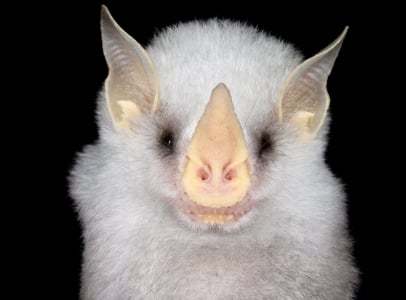
Cave-dwelling bats are cloistered away from most predators and have little need to camouflage themselves. Tree-dwelling bats, however, are exposed to predators and have a much greater need to conceal themselves. Hoary bats, one of the most widespread bat species of the Americas, are thus named because of the dense fur of brown to silver-gray that gives them a frosty (or hoary) appearance. This fur coloration camouflages them against the foliage of mature deciduous and coniferous trees. Honduran white bats cluster under leaves. Their white fur takes on the greenish tint of the sunlight filtered through the leaves, making them look as though they are parts of the leaves.

Why do eastern red bats roost in certain trees?
Eastern red bats are the most abundant tree dwelling bats in North America. They don’t wait for full nightfall to take to the skies, preferring the early evening to flit about clearings, forest edges, or city streetlights to pursue their dinners of moths and other insects. If you live anywhere around forests or trees in general, from Florida north to Canada, you live around eastern red bats and have most likely seen them at dusk.
But you probably have not seen them roosting in trees because the coloration of their coats, which varies from yellowish red to brick red, lets them blend in with the masses of leaves in the crowns of trees. As with hoary bats, eastern red bats will cling to a tree branch by a single foot, swaying in the breeze like a leaf. Male eastern red bats are more brightly colored than females. For both sexes, their fur is tipped white at the ends, making the bats appear to be frosted, and females appear more frosted than males.
These bats prefer to roost in sycamore, oak, box elder, and elm trees. They choose these trees in summer, but autumn may give a clue as to why they prefer these trees for roosts. These four types of trees burst into yellows, oranges, and rich reds when cooler fall weather “paints” their leaves. On the other hand, autumn has maples changing color to magenta, chestnut trees retaining a great deal of green, and magnolias can be yellowish green before they fall from the branch.
Could it be that the eastern red bat prefers sycamore, oak, box elder, and elm trees because their fur more closely resembles the leaves of these trees when autumn comes around? Scientific understanding of eastern red bats and their roosting behavior could help in making conservation and forestry decisions, and could help in the survival of this species and other bat species.