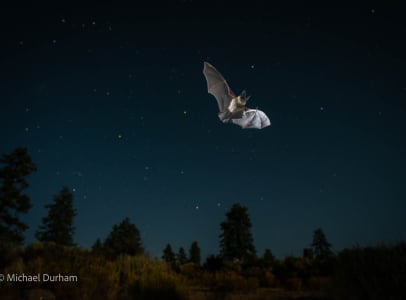
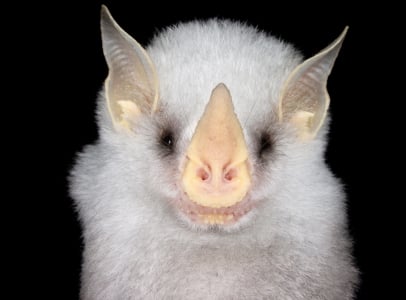
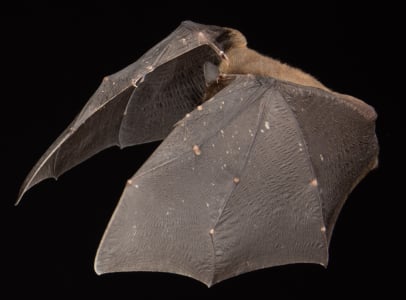
The fish-eating myotis and the greater bulldog bat have evolved to become the envy of even the most skilled angler.
12.06.24
By Paul Hormick

A lot of bat species are insectivores. Other species eat fruit, while others visit flowers for nectar. And vampire bats have developed a taste for blood. Little known, however, are two species that specialize in fishing. The fish-eating myotis (Myotis vivesi) and the greater bulldog bat (Noctilio leporinus) have evolved flight and even feet that enable them to subsist mostly on fish.

Both bats use large, long wings to glide and swoop, hawklike, over bodies of water to catch their prey. Although their flight lacks the maneuverability of other bats, their large wings give the bats enough lift to catch and carry their heavy prey. Some fishing bats can catch and consume as much as 30 fish in a night.
Besides the large wings, both of these bat species have really large, Sasquatch-like feet. Fish-eating myotis have feet that comprise almost 15 percent of their total body length. If a male human, standing 5’ 10”, had similarly proportioned feet, he would wear a size 14 shoe! Both species have claws extending from their large feet (see photos).
Flying low and slow, fish-eating myotis bats comb the upper reaches of a body of water with their large feet to catch prey.

Fish-eating myotis live among islands and the rocky coasts on the Sea of Cortez, the body of water between mainland Mexico and the Baja Peninsula. Habitat also includes the western Pacific shores of Baja. These bats roost in caves and rock crevices, and also along the shoreline under flat stones and turtle shells. They sometimes share their roosts with two species of petrals, common shorebirds of Baja. On many of the islands, the western whiptail is a predator of the birds’ eggs and chicks. The bats are much more aggressive at warding off these lizards, flapping their wings and biting the whiptails when they get close to the bats’ roosts. This may be an example of a bird species evolving a roosting strategy that allows them to benefit from the bats’ behavior.
Flying low and slow, the myotis bats comb the upper reaches of a body of water with their large feet to catch prey. Sometimes it appears that they drag their feet behind them through the water. Their toes and large claws are compressed to minimize drag as they skim. Though they feed mostly on fish and crustaceans, they also eat algae and insects. Interestingly, the color of their guano changes according to what they eat.
Fish-eating myotis can fly great distances in a night both on and off the shore of Baja. Much of the peninsula is quite arid, with few sources of fresh water. The bat is adapted to these conditions. With kidneys that concentrate urine, the bat is able to drink seawater, one of the very few land mammals that is able to do so.
If they sense that there are many fish in a section of water, greater bulldog bats will rake across the water in swaths that can reach 30 feet in length.

The greater bulldog bat inhabits a much larger area than the myotis, ranging from Mexico through Central and South America to northern Argentina. They also live throughout the islands of the Caribbean, including Cuba, Granada, and Jamaica. Often roosting in the hollows of trees, these bats live in colonies that sometimes number into the hundreds. Colonies may be made up of mixed or single sex groups, and this may vary seasonally. They favor living in in river basins, coastal areas, and lowlands that receive plentiful rainfall. At dusk and into the night, greater bulldog bats can be spotted flying over streams, ponds, estuaries, and coastal lagoons.
When they forage, greater bulldog bats can use multiple strategies. They may fly high, in a circular motion up to 50 cm above the surface, using echolocation to detect fish by the ripples they make, or they may fly very low, up to 10 cm above the surface. They may drag their feet randomly, or in a directed way. If the bats detect fish, they decrease the pulse duration and intervals of their echolocation calls before they strike. If they sense that there are many fish in a section of a pond, lake or other body of water, these bats will rake across the water in swaths that can reach 30 feet in length. As they fly, the bats face their feet forward and instantly grab any fish they contact. Foraging behaviors and diet can vary seasonally, and they are also known to eat insects, shrimp, crabs, and scorpions.

Bat conservation research and conservation efforts can support both of these fish-eating bats. The greater bulldog bat was assessed in the State of the Bats of North America, which identified threats to this species stemming from agricultural and forestry effluents, tourism and recreation activities, and droughts. There is even greater concern for the fish-eating myotis, as it has a restricted range and a declining population. These bats face multiple threats, including habitat loss and climate change as well as serious damage from introduced predators, such as rats and domestic cats. By spreading awareness about the incredible adaptations of fishing bats, you can help amplify support for bat conservation that leads to successful outcomes for these species.