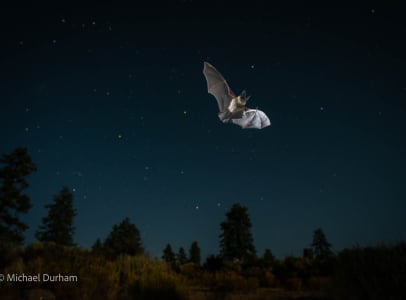
A few bat species have evolved to thrive in the world’s deserts.
02.06.25
By Paul Hormick

As they have proven themselves to be among the most adaptable of mammals, a number of bat species have evolved to cope with the heat and lack of water in the world’s deserts. These bats have found ways to find shelter and catch prey in these challenging environments. In so doing, they fill ecological niches and sometimes aid humans in the parched parts of the world.

Unsurprisingly, bats congregate around oases or other sources of freshwater in deserts. They also use go into torpor to survive the harsh conditions of deserts. While in this state of lowered metabolism, bats reduce the amount of water they need, and they may use this survival mechanism during times when ponds and washes dry up. Torpor also gives them a way to regulate body temperature during the scorching heat of desert summers.
Desert long-eared bats (Otonycteris hemprichii) live in the arid and semi-arid regions of North Africa and the Arabian Peninsula and as far east as Pakistan, roosting in rocky crevices or occasionally in buildings. This small member of the microbat family forages close to ground level and uses echolocation to find flying as well as ground-dwelling insects and invertebrates such as crickets, scorpions, beetles, and cockroaches.
By being nocturnal, bats are predisposed to thrive in dry environments with soaring temperatures.

Scorpions can comprise up to 70 percent of this bat’s diet. Once a desert long-eared bat catches a scorpion, and attempts to bite the head off of the venomous arachnid, the scorpion will naturally fight back, often by stinging the bat in the face. The bats appear to feel pain from the stings, but have adapted to this desert diet by evolving immunity to the scorpion venom, even the very venomous Palestine yellow scorpion. The pallid bat (Antrozous pallidus), a medium-large bat that lives in arid regions of western North America also eats scorpions as part of its diet and has also developed immunity to their stings.
The only bat in the world that hunts exclusively over the ocean, the fish-eating myotis (Myotis vivesi) feeds on fish it catches in the Sea of Cortez. The lands adjacent to this body of water where the bat lives, the Baja Peninsula and western coast of Mexico, are quite arid. Much of this part of the world receives less than an inch of rain annually. As there may be no source of freshwater for months and months, the myotis has developed kidneys that can concentrate urine, enabling it to survive by drinking seawater.

Arid Acclimators
Kuhl’s pipistrelle (Pipistrellus kuhlii) is an example of a bat that can turn an adaptation off and on. It lives in a number of environments throughout southern Europe and North Africa, from the coast of France to Pakistan. When this small bat lives in the deserts of North Africa or other dry places, it changes the fat content of its skin and reduces the amount of water lost from its body surface. A research project found that the desert-dwelling Kuhl’s pipistrelles reduced their total water loss by 20 percent compared to bats of the same size who did not live in deserts.
By being nocturnal, bats are predisposed to thrive in dry environments with soaring temperatures. Cacti of the American Southwest and Mexico have evolved a symbiotic relationship with their nighttime bat pollinators. Organ pipe and saguaro cacti are primarily open at night, attracting pollinators like lesser long-nosed bats (Leptonycteris yerbabuenae), who use their extra-long tongues to reach deep inside the blooms for their sips of nectar. Besides pollinating these plants, the bats also disperse the cacti’s seeds after consuming their fruit.

People have farmed dates in arid regions of the Middle East since biblical times. It was only recently, however, that researchers found several species of desert bats that feed on date pests, apparently aiding farmers for thousands of years.
Unfortunately, deserts around the world are facing increased challenges due to overgrazing, unsustainable agriculture, and climate change, posing threats to bats and other animals, including humans. Climate change is drying up water sources in deserts and making larger bodies of water smaller. Bats drink on the fly, scooping up a sip as they swoop over a body of water. Fewer and smaller bodies of water in deserts make these drinking dips more difficult, especially for larger bats.

Bat Conservation International supports desert-dwelling bats through conservation and restoration. BCI’s Habitat Protection and Restoration (HP&R) Program works across the American West to restore habitats and water resources for bats and other wildlife. The Agave Restoration Initiative seeks to plant 500,000 agaves and protect and restore 230,000 acres of land, establish 20 greenhouses, and support 50 communities by 2035 throughout Mexico and the American Southwest. The agaves provide nectar for pollinator species, such as the Endangered Mexican long-nosed bat (Leptonycteris nivalis) and the lesser long-nosed bat. Your support of BCI keeps programs like these alive for desert dwelling bats and bats throughout the world.
BCI’s Habitat Protection and Restoration Program works across the American West to restore habitats and water resources for bats and other wildlife.
Learn more information about BCI’s Agave Restoration initiative at: batcon.org/batsandagave and batcon.org/agaverestoration