Unravelling the enigma of Wroughton’s free-tailed bat
01.22.26
By Sreejith Jayakumar


The sun had just set, and the winter sky had turned into a shade of red, casting an almost dystopian glow over the landscape. I was standing on a plateau with sheer drops on both sides and the view from up there was amazing.
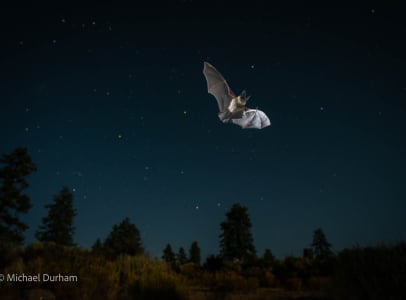
Suddenly, I noticed a bat flying above me. I switched on my acoustic recorder. The screen lit up with a series of clear and strong pulses. I looked closely; it was an Egyptian free-tailed bat.
I showed the calls to my teammate Ashish.
“Wow,” he said, surprised. “I can actually hear them.”
“Typical Molossids,” I replied. Free-tailed bats belong to the family Molossidae, a group known for producing echolocation calls that can sometimes fall within the human audible range.
“I want to,” I said. “I never got the chance, but at least I hope I’ll get to record it one day”
Then Ashish asked, “Have you ever seen Wroughton’s free-tailed bat?”

At the time, that felt like wishful thinking. But after a few months, I realized I had done exactly that. I ended up recording the very species I had once hoped to, which became the most recent addition to the known distribution of Otomops wroughtoni in India.
“This handsome bat forms one of the most showy and striking discoveries of recent years, so far as Indian mammalogy is concerned.”
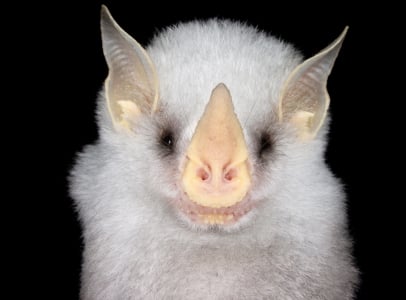
That is how British zoologist Oldfield Thomas described the Wroughton’s free-tailed bat, when he introduced the species for the first time in 1913. Like a magician wearing a black and white tuxedo giving a sense of mystery and spectacle, it remains just as striking more than a century later.
A Rare and Elusive History

The species was first discovered in 1912 from a cave in the Western Ghats biodiversity hotspot. For the next 88 years, that single cave was the only known roost of the species in the world. At the time, its rarity made it one out of only two protected bats in India (the other being the endangered Salim Ali’s Fruit Bat). Then suddenly, scattered discoveries began to emerge. One individual was captured in Cambodia in 2001, another was found in Meghalaya of northeast India in 2002. Further surveys in 2014 and 2021 revealed a few more roosts in Meghalaya. Today, only seven roosting locations of this species are known globally.
Ironically, these discoveries led to the species being moved from Critically Endangered to Data Deficient, not because it became safer, but because we still know too little about it. It is also known for something extraordinary; this is the only bat species in Indian wildlife history that directly contributed to a forest being declared as a wildlife sanctuary. The species can be called “The bat that saved a forest” (the full story is beautifully documented in a blog by Rohit Chakravarty, BCI’s India Program Manager).
This is the only bat species in Indian wildlife history that directly contributed to a forest being declared as a wildlife sanctuary.
New Discoveries
In 2024, a single individual of the Wroughton’s free-tailed bat was observed inside a biodiversity park in the Delhi-NCR, Capital Region of India. This raised many questions. How did it get there? Was it a vagrant individual? Or could there be an undiscovered roost nearby? But as of now, no one knows.

Most recently, the species was acoustically detected in Sri Lanka, it is the first confirmed record from the country. Once again, it was acoustics that revealed its presence. These discoveries highlight how powerful and essential acoustic surveys are, especially for elusive species like this one.
Every known roost of Wroughton’s free-tailed bat is inside a cave. These bats prefer humid caves surrounded by vegetation. Even within the cave, they choose tiny crevices and dome-like structures near the roof. This positioning helps them drop straight down to gain speed before taking flight. But it also makes them difficult to study or count as they are hidden deep inside.
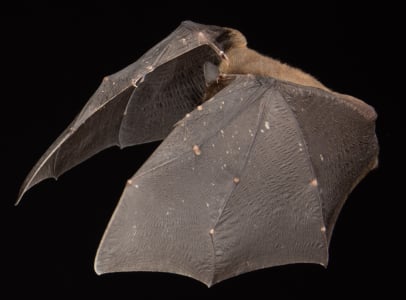
These bats are powerful flyers, capable of travelling long distances in a single night at high elevations. They hunt insects in open areas, using low-frequency echolocation calls that travel far through the air.
These discoveries highlight how powerful and essential acoustic surveys are, especially for elusive species.
The Future

Even after more than a century since its discovery, we still know remarkably little about Wroughton’s free-tailed bat, its population size, movement patterns and breeding behaviour.
And the threats are growing. I detected this species while studying the effects of wind energy on bats as part of BCI’s efforts to identify priority conservation initiatives in India. The fact that such a rare species was active inside a wind farm is deeply concerning. Wind turbines are one of the major concerns for species such as Wroughton’s free-tailed bat. Given their high-altitude foraging beahavior, there is high risk of collision. There are already reports of mortality of Otomops harrisoni, a closely related species, at wind energy facilities in Kenya.
India currently does not mandate Environmental Impact Assessments before installing wind turbines. This creates serious gaps in protecting species like this due to lapses formed while citing wind farms. Even though the Wroughton’s Free-tailed Bat is listed under Schedule I of India’s Wildlife Protection Act, granting it the highest level of legal protection in India, wind energy, unregulated limestone and coal mining, logging, and habitat degradation threaten the species’ survival.
All recent discoveries of Wroughton’s free-tailed bat point to one thing, we have only scratched the surface. We urgently need focused studies to understand its ecology, behaviour and conservation needs. There is still a long way to go, but every journey has to start somewhere.
Sreejith Jayakumar is currently studying the effects of wind energy on bats in India at the Nature Conservation Foundation. When he is not in the field or analysing data, he enjoys climbing and a bit of caving.