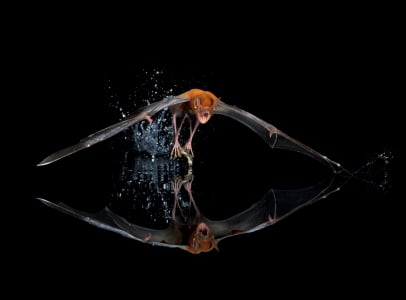
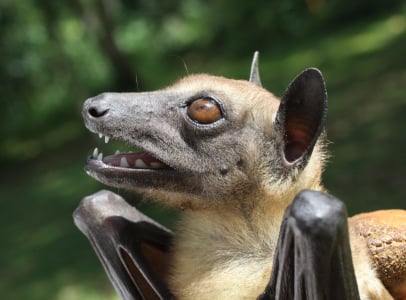
New Zealand’s native bats are incredibly rare and elusive.
10.04.24
By Paul Hormick

New Zealand has only two native species of land mammals, both of which are bats. The long-tailed bat (Chalinolobus tuberculatus) lives throughout the islands, while the lesser short-tailed bat (Mystacina tuberculata), which comprises three subspecies, is found in geographically restricted areas of the North and South islands, as well as a few of the smaller islands of the Pacific nation. Māori folklore refer to bats as pekapeka and associates them with the mythical, night-flying bird, hōkioi, which foretells death or disaster.

A third species, the greater short-tailed bat (Mystacina robusta), had been found on two small islands off the southern end of the South Island. Last seen in 1967, they are almost certainly extinct, victims of ship rats introduced to New Zealand. Without diligent conservation efforts, that fate threatens the remaining bat species as well.
Although their names suggest a close relationship, short-tailed and long-tailed bats are not closely related and are from different bat families. The long-tailed bat is a Vespertilionid, one of the most diverse and widely distributed bat families. Short-tailed bats are the only surviving species of the bat family Mystacinidae.
Recent paleontology field work has found short-tailed bats to have been among the first creatures to colonize New Zealand, predating the arrival of iconic species of the islands, such as the kiwi, by millions of years. No one is certain how they reached the shores of the islands, but scientists speculate that they arrived from Australia as long as 16- to 18-million years ago. Long-tailed bats are relative newcomers, landing in New Zealand around two-million years ago. They are closely related to bat species in Australia.
Through the 1800s, the long-tailed bat remained quite common throughout New Zealand, but by the turn of the 20th century, they had grown scarce in many regions. Today, the New Zealand Department of Conservation classifies the conservation status of this small, chestnut brown bat as Threatened, Nationally Critical, the most serious designation, meaning the species faces “an immediate high risk of extinction.” Two subspecies of the short-tailed bat are listed as Threatened, facing possible extinction; the third is moderately common but still declining in numbers.
Logging, converting wildlands into agricultural and urban areas, and introduced predator species, such as rats and stoats, are among the threats for both species. Despite their dwindled numbers, New Zealanders can still sometimes see long-tailed bats, as they take wing at dusk in rural areas and along forest edges, fluttering like large butterflies. Sightings in urban areas are rare, however townsfolk of Geraldine, a small town on the South Island, are often treated to views of long-tailed bats as they emerge from the nearby Talbot Forest Scenic Preserve to catch their diet of mosquitoes, moths, midges, and beetles on the fly.
Unlike almost all other bats, short-tailed bats walk, spending up to 40 percent of their foraging time scurrying over fallen tree branches and forest floors.
Unlike almost all other bats, short-tailed bats walk, spending up to 40 percent of their foraging time scurrying over fallen tree branches and forest floors pursuing their diet of insects, fruit, nectar, and pollen. Walking on backwards facing feet and the equivalent of their wrists might seem awkward, but these bats scurry about with great agility. Secondary talons, unique to the species, at the base of the toe claw and the bat’s equivalent of their thumbs increase their ability to grab hold of the forest substrate. Their feet pads also possess tiny grooves, enabling them to adhere to surfaces, much as geckos do.
These light grey bats with large pointy ears can hide their wings beneath a leathery membrane and fold back their long ears as they dive under leaf litter to seek their meals. They have broad wings with tough membranes, attributes that serve them well when they have the task of taking flight from the forest floor. Evidence suggests that these omnivorous bats are important pollinators of the rare and endangered wood rose, a fully parasitic native flowering plant native to New Zealand that grows on the roots of forest trees. Although, this bat will crawl under snow, it will go into short-term torpor during the wettest days of summers or the coldest times of winter. Long-tailed bats will also go into torpor during these times.

As conservation assessments continue, researchers have found a bit of good news for both species. Numbers of long-tailed bats had been dwindling by five percent annually, but, starting in 1990, a conservation effort controlling exotic predators has turned things around, and the bat’s population has been increasing by four percent per year. Recovery for the short-tailed bat has been even better. A population of only 300 in the Eglinton Valley on the South Island grew to almost 3,000 in 2018. Other populations of short-tailed bats have increased, leading to an overall increase of 65 percent of their numbers.
These increasing numbers are heartening, yet naturalists in New Zealand warn that if predator control doesn’t continue, extinction for both species is almost certain. And through everything from research scholarships to habitat restoration Bat Conservation International is helping to ensure a future for New Zealand’s bats and other bat species throughout the world.