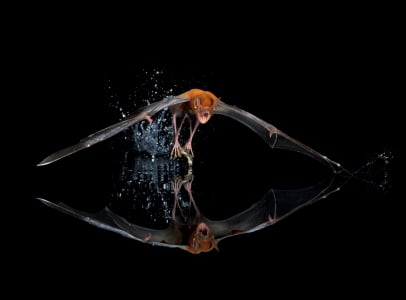
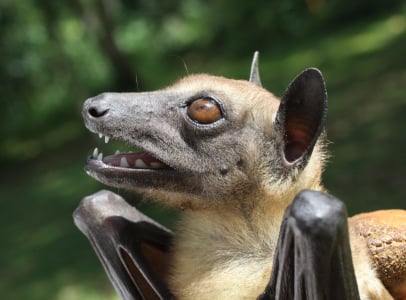
Distinguished among raptors, the bat hawk feeds primarily on bats.
10.21.26
By Paul Hormick

If bats produced horror films, there is one predator that would play a lurking role. Imagine being a fruit bat in Zambia or Madagascar. You’ve just left your roost for a night of fruitful foraging through a tropical forest, when you hear a short, repeated wheet wheet wheet! That call means it’s time for some evasive moves — and quick! What you’ve just heard is the ominous call of the bat hawk (Macheiramphus alcinus), a raptor so named because it hunts bats.
Bats have evolved to be mostly free of predation. One theory of bat behavior posits that bats evolved to fly at night to avoid predation, particularly by birds. There are nonetheless dozens of raptors that, at least on occasion, will feed on bats. Distinguished among raptors, the bat hawk feeds primarily on bats. Small birds comprise a portion of their diet, and they will also eat reptiles and insects. But when it comes to the main course of an evening’s meal, its bats, bats, and more bats.
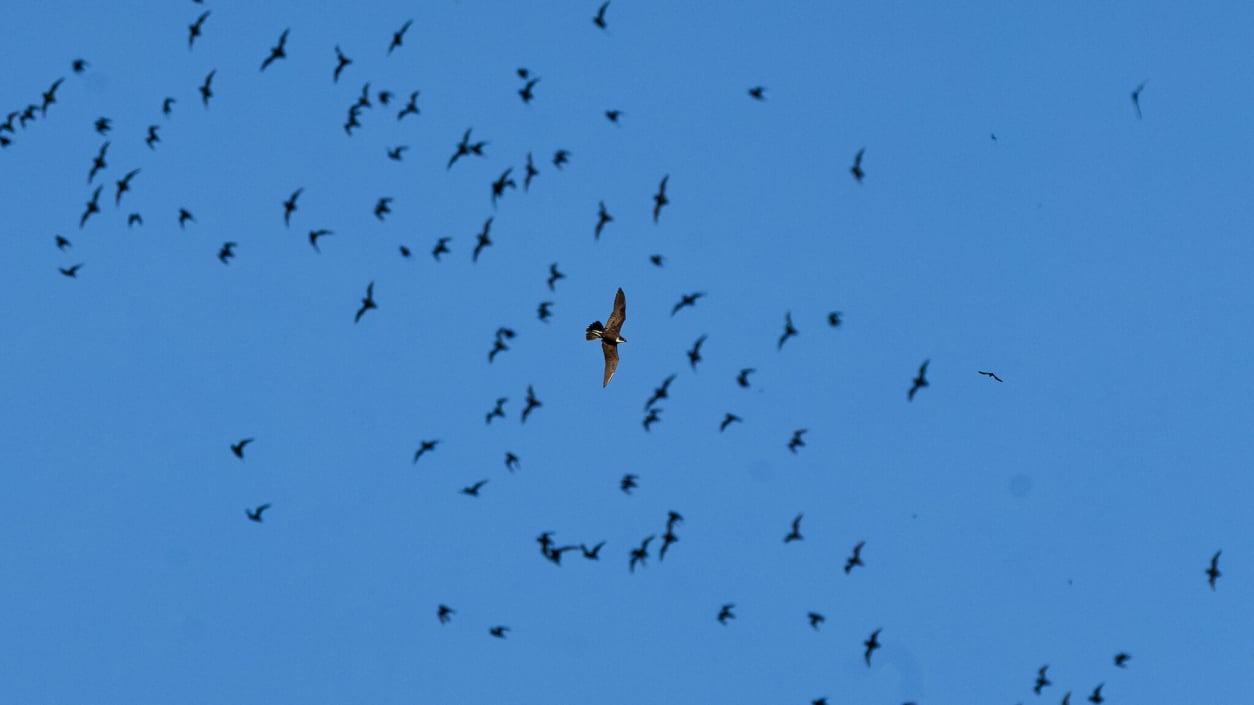
Enabling this grab and gobble avian version of fast food are the large gapings of these hawks’ beaks. You can think of this as basically how wide this bird can open its mouth. Of all raptors, the bat hawk has the largest gape, one that resembles the gape of insectivorous birds, which also swallow prey whole in flight.
When it comes to the main course of an evening’s meal, its bats, bats, and more bats.
Ornithologists recognize three subspecies of bat hawks that are native to the Old World tropics. The most populous and widespread is the African bat hawk Macheiramphus alcinus ssp. anderssoni), which lives throughout central Africa and Madagascar. The Asian bat hawk (Macheiramphus alcinus ssp. alcinus) is found in Thailand, Malaysia, and Sumatra. And occupying a portion of West Papua on the Indonesian island of New Guinea is the Papuan bat hawk (Macheiramphus alcinus ssp. papuanus).

Ornithologists recognize three subspecies of bat hawks that are native to the Old World tropics. The most populous and widespread is the African bat hawk Macheiramphus alcinus ssp. anderssoni), which lives throughout central Africa and Madagascar. The Asian bat hawk (Macheiramphus alcinus ssp. alcinus) is found in Thailand, Malaysia, and Sumatra. And occupying a portion of West Papua on the Indonesian island of New Guinea is the Papuan bat hawk (Macheiramphus alcinus ssp. papuanus).

Brownish black, with a white chin, the African bat hawk has mottling of white, especially on its breast, while the Asian and Papuan birds have solid coloring. All bat hawks have striking, amber eyes. Their long, slender wings enable them to fly swiftly for pursuing bats. And with the angular shape of their wings, they resemble swifts in flight. They catch their prey with small talons.
One might expect bat hawks to be nocturnal, like bats, but they are crepuscular. Largely inactive while the sun is high on the horizon, they hunt at dawn and dusk and feed for about 30 minutes, sometimes longer into the night if the light is good. In one scientific observation, a bat hawk fed on seven bats in just over 18 minutes.
In one scientific observation, a bat hawk fed on seven bats in just over 18 minutes.
Both male and female bat hawks participate in constructing their nests, which they build out of sticks in tall, leafy trees, such as native baobab or introduced eucalypt. The hawks will line the nests with smaller twigs and sometimes leaves. They will often settle in to the same nesting site for many years. Eggs are laid from August through February, peaking during September and October. In urban areas, eggs may be laid throughout the year. The timing of their reproductive cycle is also influenced by bats. Fledglings are usually born by October. This timing coincides with the rainy season throughout much of the bat hawk’s range, a time of peak abundance for tropical insectivorous bats, as the bats feast on the increased number of insects brought about by the rains.

A bat hawk stalking prey. Fret not bat fans, bat populations do not seem to be adversely affected by bat hawk predation and there is no current research or other indication that bat hawks are reducing bat numbers. By Abujudy/iNaturalist
Predation from this hawk, as well as other aerial hawking birds, may be the reason why so many insectivorous bats in the tropics evolved whitish wings. Scientists believe natural selection may have favored bats with lighter coloration because they are more difficult to distinguish in the dimmer light of dusk and dawn. But fret not bat fans, bat populations do not seem to be adversely affected by bat hawk predation and there is no current research or other indication that bat hawks are reducing bat numbers.
Due to its large range, the International Union for Conservation of Nature lists the bat hawk as a species of Least Concern, and it is believed that the population, numbering between 670 and 6,700, is stable, although the Asian subspecies may be declining in Borneo.
So, if you thought bats were frightening, just remember, there are predators in the natural world that bats are frightened of too — prowling the misty dawn and dusk with bated breath and large mouths agape.
Paul Hormick, author of the environmental newsletter The Green Dispatch, has spent the last 22 years writing about music, food, and the environment.