Meet the bats working the pollinator night shift.
06.24.26
By Alyson Brokaw

Who clocks in when the birds and bees clock out? To celebrate Pollinator Week, let’s follow the night as it travels westward around the globe to meet just some of the bats working the pollinator night shift.
Sunset in American Samoa
A golden late afternoon sun glints out from behind towering banyan trees on Ofu, one of American Samoa’s small volcanic islands. Fruit doves coo from beneath the canopy as a large, dark shadow swoops by. Landing amongst the foliage of an Indian coral tree (Erythina variegata), a Samoan flying fox (Pteropus samoensis) turns to stick its nose into the spiky, red flowers, lapping up nectar.

A striking plant, the Indian coral tree is valued as a decorative tree, but also in agroforestry and traditional medicine. The only land mammals native to these Pacific islands, the Samoan flying fox and the Tonga flying fox (Pteropus tonganus), are helpful pollinators, also visiting native vines like Freycinetia reineckii, a climby woody plant of the forest understory. Unlike other bats who are strictly nocturnal, these flying foxes will share the daytime pollinator shift with birds, though they extend their activity later into the evening.

Eventide in the East
As we move several thousand kilometers to the west, dusk settles over eucalyptus forest and coastal scrublands of eastern Australia. The pale-yellow flower spikes of the coastal banksia (Banksia integrifolia) glow faintly in the fading light. Banksia flowers produce most of their nectar and pollen at night, suggesting a particular reliance on nocturnal visitors. Common blossom bats (Syconycteris australis) are one of these nocturnal visitors. When feeding from the flowers, bats get covered in pollen, making them particularly effective at moving pollen from plant to plant (especially when compared to bird visitors such as honeyeaters).
In northern Queensland, the native rainforest tree rose apple (Syzygium cormiflorum) also benefits from the services of blossom bats. Though bats are less frequent visitors to these flowers, bats carry six times more pollen than birds and are willing to fly across gaps in the canopy, thus ensuring continued gene flow even in fragmented forest landscapes.

Across Australia, bats are the main characters of pollination for the iconic eucalyptus forests. Bats like the little red flying fox (Pteropus scapulatus), spectacled flying fox (Pteropus conspicillatus), and grey-headed flying fox (Pteropus poliocephalus) roam long distances in search of blooming flowers. The resulting ecological and economic “bat ripple” effects are staggering: the median contribution of grey-headed flying fox pollination services to Australia’s eucalypt timber industry has been estimated at over $600 million AUD per year (with seed dispersal services contributing to recruitment of 13.9 million trees annually). The bats’ collective ‘service area’ spans up to 41 million hectares, an area roughly the size of Sweden!
Meanwhile in the northern hemisphere, the lush hills of Okinawajima Island, Japan rise dark and dense against the last wash of daylight. Beneath the canopy, pendulous bunches of purple and green flowers hang from the vines of rusty-leaf mucuna (Mucuna macrocarpa) and a Ryuku flying fox (Pteropus dasymallus) has found them. The bat hooks a clawed thumb around a flower, pulling it closer. As the bat pushes its nose into the base of the flower, a tiny trigger at the base of the flower fires, hitting the bat’s face with a big puff of pollen. This “explosive opening” gives the bat access to the nectar within and bats may be the only visitors who can set it off, making them critical partners in this plant’s reproduction.
Across the world, in deserts and rainforests, on remote islands and over farmlands, bats have been hard at work while other pollinators sleep.

Sundown in South Asia
The rising sliver of the moon glints off the waves as they lap gently against the mangrove coastline of peninsular Malaysia. Prominent pink and white stamens stick out from a bright pink base as the flower of a mangrove apple (Genus: Sonneratia) opens for the night. Drawn in by their strong, sour-milk scent, cave nectar bats (Eonycteris spelaea), also known as lesser dawn bats, descend on these spiky blooms. Bats are important pollinators of these flowers, which are filled with lots of nectar but only open for one night. Besides providing edible fruit used by locals, trees like mangrove apples play important roles in protecting coastlines from erosion, acting like a natural seawall that reduces wave energy during storms.
Meanwhile, nearby at the edge of a durian plantation, island flying foxes (P. hypomelanus) land in the canopy of durian trees, crawling sideways to reach the creamy white flowers clustered along the branches. With surprisingly delicate touch, the bats lick nectar from one flower before moving on to the next. Durian, the pungent, spiky fruit popular across Southeast Asia, gets a hefty benefit from these bat visits. When bats were excluded from flowers with netting, fruit set significantly decreased and it estimated the economic value of these bat pollinators can reach up to $450,000 USD annually.

Across the Bay of Bengal, night has already settled over the forests and farmlands of South Asia. While many of the bats here are best known for their fruit-eating, they also contribute an estimated 88% of all mammalian pollination services, valued at an estimated £479,580 ($643,279 USD). Bats seen visiting Indian flowering plants include short-nosed fruit bats (Genus: Cynopterus), Indian flying fox (P. giganteus), and Leschenault’s rousette (Rousettus leschenaultii).

Late Nights in Sub-Saharan Africa
The night that swept over the Pacific hours ago has now reached the African continent. The barrel-trunk and wide-reaching branches of a baobab paint a dark silhouette against the star-filled night sky. Open flowers with white petals and a fluffy ball of stamens hang from the branches of this iconic savannah tree, waiting for nighttime visitors. Visits from bats like the straw-colored fruit bat (Eidolon helvum) and epauletted fruit bat (Genus: Epomorphous) to baobabs can help improve fruit set and increase reproduction.

In open woodland and near waterways of sub-Saharan Africa, African sausage trees (Kigelia africana) hang their dark red flowers low and open, available to epauletted fruit bats, sunbirds and bulbuls. The competition is not equal, as bats have been shown to deposit up to 20 times more pollen than their avian counterparts.
Throughout Africa, bats are also important pollinators of a range of plants, including kapok (Ceiba pentandra) and Dawdawa (Parkia spp). Smaller fruit bats like pygmy fruit bat (Nanonycteris veldkampii) like to visit these plants, crawling all over the flowers and getting themselves covered in pollen as they do. African long-tongued bats (Megaloglossus woermanni) have also been observed drinking nectar from cultivated banana plantations (though these are not the Cavendish bananas most of us are familiar with).
Stars and Shadows in South America
As night stretches across the Atlantic Ocean, we come to the northern and eastern shores of South America. Pale, thorny trees and tall, branching cacti stretch across the landscape of Brazil’s Caatinga, the largest dry tropical forest on the continent. Wings blurring as they hover above pale white cactus flowers, a Pallas’s long-tongued bat (Glossopha soricina) extends a long tongue. Nearby, a much larger spear-nosed bat (Phyllostomus hastatus) crashes against a similar flower, coming away covered in yellow pollen. These bats, along with others like the endemic Viera’s long-tongued bat (Xeronycteris vierai) pollinate at least 36 plants in this Brazilian biodiversity hotspot, including kapok (Ceiba), tree cactus (Pilocereus), orchid trees (Bauhinia), and passionflower.

Bats carry six times more pollen than birds and are willing to fly across gaps in the canopy, thus ensuring continued gene flow even in fragmented forest landscapes.
The tropical and subtropics of the western hemisphere is home to the incredibly diverse bat family Phyllostomidae, also referred to as the neotropical leaf-nosed bats. Across the Americas, at least 61 species of bat feed on flowers, helping pollinate at least 360 species of flowering plants. Some of these bats are flower-visiting specialists, with hummingbird-like hovering flight and long tongues adapted for rapidly extracting nectar. Others are primarily fruit-eating bats, who are a little more clumsy, visiting flowers by perching and climbing to access nectar and pollen.
Westward and upward, the night creeps over the cloud forests draped along the Andes’ western slopes in Ecuador. Here the air is cool and heavy with mist and the forest dotted with a variety of long and tubular flowers. Long-tongued bats (Genus Anoura) spend their nights flitting from one flower to another, feeding from flowers specially adapted for bat pollination. One bat-flower pair takes this specialization to the extreme: with a tongue that can extend to nearly 1.5 times its body length, the tube-lipped nectar bat (Anoura fistulata) may be the only animal able to reach the nectar at the bottom of the Centropogon nigricans flower.

Night Moves North
The low light of the crescent moon glints off the trees in the lowland forests of Panama. Broad, creamy white flowers face upwards from the branches of a balsa tree (Ochroma pyramidale). These trees, known for their lightweight wood, are pollinated by a suite of mammals, including bats, kinkajous, olingos, and opossums.
Continuing north, spiky agave, columnar cacti, and saguaro stand tall against the star-splatted sky. In these iconic deserts of Mexico and the southwest United States, nectar feeding bats help sustain the ecologically and economically important plants. Agave plants are used to make a variety of culturally important products, including tequila, mezcal, pulque, and bacanora, while the plant fibers are used for weaving and building fences. Long-nosed bats (Leptonycteris yerbabuenae and Mexican long-nosed bats (Leptonycteris nivalis) rely on these plants during their seasonal movements, and pollination by bats and other nocturnal visitors improves fruit set and genetic health of these keystone plants.
Agave is not the only commercially important plant to rely on bats for pollination. Pitaya (Stenocereus queretaroensis, also known as dragonfruit) is a major crop in central Mexico. When bats were experimentally excluded from pollinating pitaya flowers, resulting fruit yield dropped by 35%. Bat pollination also improves fruit size and sweetness, making bats worth an estimated $2,500 per hectare in ecosystem services.
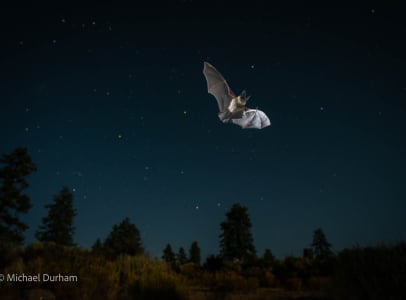
And while leaf-nosed bats continue to shine when it comes to western hemisphere bat-pollination, sometimes the bats surprise us. Pallid bats (Antrozous pallidus), most well known for their ability to hunt down scorpions, also enjoy a sweet nectar treat. They may even be more effective pollinators than specialists, delivering significantly more pollen grains per visit to cardon cactus flowers than the more specialized lesser long-nosed bat.

As Dawn Breaks
Somewhere over the Pacific, light hits island shores as a new day begins. Bats return to their daytime roosts to sleep, bellies full from a nighttime of floral foraging. Across the world, in deserts and rainforests, on remote islands and over farmlands, bats have been hard at work while other pollinators sleep. This Pollinator Week, don’t forget to thank the batty night shift.
Alyson Brokaw, PhD is a behavioral ecologist, sensory biologist, science communicator, and a regular contributor to The Bat Pub. When not talking about bats, she can be found cuddling with her dog, exploring her local Pennsylvania woods and throwing plastic on the ultimate frisbee field.